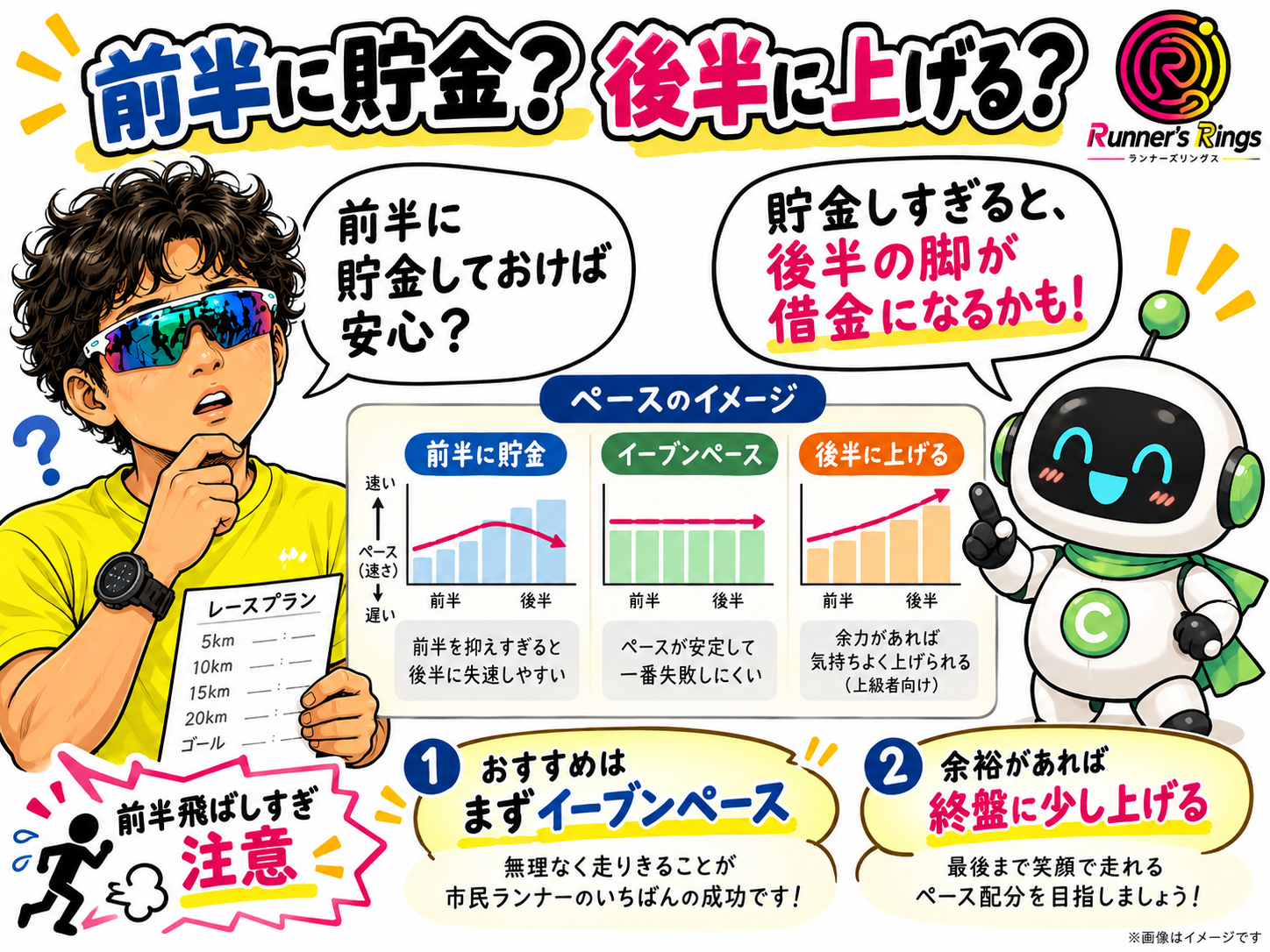
Should Marathon Runners Bank Time Early or Finish Faster? Chappy Explains the Science
Should marathon runners build a time cushion in the first half or save their strength for a faster finish? At the 2026 Amsterdam Marathon, both champions achieved negative splits. But that does not mean every recreational runner should copy elite racing tactics. Drawing on pacing research involving nearly 79,000 marathon finishers, Chappy explains positive, even, and negative splits—and why realistic, consistent pacing may be the most useful starting point.
Should you bank time during the first half of a marathon?
Or should you start conservatively and finish faster?
It is a question many marathon runners have considered.
At first, banking time sounds logical.
Run faster while you feel fresh.
Then use that time cushion if you slow down later.
But does that strategy actually work?
■ What happened in Amsterdam?
At the Amsterdam Marathon on October 18, 2026, Ethiopia's Buze Diriba won the women's race in 2:16:12, setting a course record.
Lemi Berhanu won the men's race in 2:03:33.
Both champions achieved negative splits, completing the second half faster than the first.
It was an impressive display of late-race strength in wet conditions.
But copying an elite runner's pacing strategy does not guarantee a personal best for a recreational marathoner.
■ Three main pacing strategies
Positive split:
The second half is slower than the first.
Example:
First half: 1:42
Second half: 1:48
Total: 3:30
Even pacing:
Both halves take approximately the same time.
Example:
First half: 1:45
Second half: 1:45
Total: 3:30
Negative split:
The second half is faster than the first.
Example:
First half: 1:46
Second half: 1:44
Total: 3:30
All three examples produce the same finish time, but they distribute the effort differently.
■ Is an early time cushion really a cushion?
Imagine a runner targeting 5:00 per kilometer.
If they run the first 10 kilometers at 4:45 per kilometer, they gain 2 minutes and 30 seconds against their original schedule.
That looks like a time cushion.
But the faster pace may also increase energy use and muscular stress.
The runner may have gained time while reducing their capacity to hold pace later.
If they slow dramatically after 35 kilometers, the early advantage can disappear quickly.
The clock may show savings, while the body is accumulating fatigue.
■ What does research suggest?
A 2026 study in PLOS ONE analyzed split times from 78,912 Boston Marathon finishers between 2015 and 2017.
Researchers identified several pacing patterns.
The even-pacing group was consistently associated with more favorable finishing times than groups characterized by severe slowing.
Among runners finishing under three hours, 82% were classified as even-paced.
Among runners finishing slower than 4:30, that proportion was 19.6%.
However, this was observational research.
It does not prove that changing pacing strategy alone will automatically make any runner faster.
Training, ability, experience, and other factors may influence both pacing patterns and finishing times.
■ Is a negative split always best?
Not necessarily.
Starting too slowly can make a time goal difficult to reach, even with a strong second half.
For example, a runner targeting sub-3:30 who reaches halfway in 1:50 would need to run the remaining half in less than 1:40.
That requires a significant acceleration.
The real goal is not to make the opening half artificially slow.
It is to choose a sustainable effort that supports the strongest overall performance.
■ Chappy's suggested starting point
For many recreational runners, even pacing is a practical starting point.
Avoid unnecessary early acceleration.
Maintain a manageable rhythm through the middle kilometers.
Protect your ability to run well after 30 kilometers.
If you still have energy near the finish, a controlled acceleration may be possible.
Weather, hills, and individual fitness should always be considered.
Holding exactly the same pace on a steep hill is not necessarily the same as maintaining consistent effort.
■ Example: running under 3:30
A sub-3:30 marathon requires approximately 4:58 per kilometer.
Here are three hypothetical approaches:
Plan A — Almost even:
First half: 1:44:30
Second half: 1:44:30
Total: 3:29:00
Plan B — Small negative split:
First half: 1:45:00
Second half: 1:44:00
Total: 3:29:00
Plan C — Early time banking:
First half: 1:41:00
Second half: 1:48:00
Total: 3:29:00
All three finish in the same time.
But Plan C demands a much faster start and may increase the risk of late-race deterioration.
The best choice depends on the runner's individual preparation and abilities.
■ Running fact 1: Negative splits do not require constant acceleration
A negative split only means that the entire second half is faster than the first.
It does not mean every kilometer must be faster than the previous kilometer.
Small fluctuations can still produce an overall negative split.
■ Running fact 2: Constant pace is not constant effort
A pace of 5:00 per kilometer on flat ground can feel very different from the same pace uphill.
Course elevation, wind, and weather affect effort.
A good marathon strategy adapts to conditions rather than treating every kilometer as identical.
■ Running fact 3: Feeling comfortable early is not a bad sign
The opening kilometers of a marathon may feel easier than expected.
That does not necessarily mean you should speed up.
There is still a long way to go.
Early comfort can be a sign that you are starting at a realistic effort level.
■ Connection to the 30km wall
Rings Journal recently explored the famous marathon wall.
Late-race slowing can involve fuel availability, accumulated muscle fatigue, heat, hydration, and pacing.
Starting too quickly can contribute to those problems.
Planning for the second half is about distributing effort across the whole 42.195 kilometers, not simply running slowly at the beginning.
■ A conversation between @atsuoebarun and Chappy
@atsuoebarun:
"If I build a time cushion early, won't I be safer when I slow down?"
Chappy:
"Maybe on the clock. But if you use too much energy making that cushion, you might slow down even more later."
@atsuoebarun:
"So I should just run slowly in the first half?"
Chappy:
"Not too slowly. The key is finding a pace you can realistically maintain for the entire race."
@atsuoebarun:
"Got it. Focus on a sustainable pace instead of banking time!"
Chappy:
"Exactly. The marathon is decided by the total time over 42.195 kilometers."
■ Conclusion
Should marathon runners bank time early or finish faster?
Chappy's practical starting point is a realistic, sustainable, near-even pace.
A negative split can be excellent, but it is not mandatory.
What matters most is avoiding a pace that is too aggressive for the runner's current capacity.
The marathon is not about reaching halfway as quickly as possible.
It is about completing the entire distance effectively.
■ Sources
World Athletics, October 18, 2026
https://worldathletics.org/competitions/world-athletics-label-road-races/news