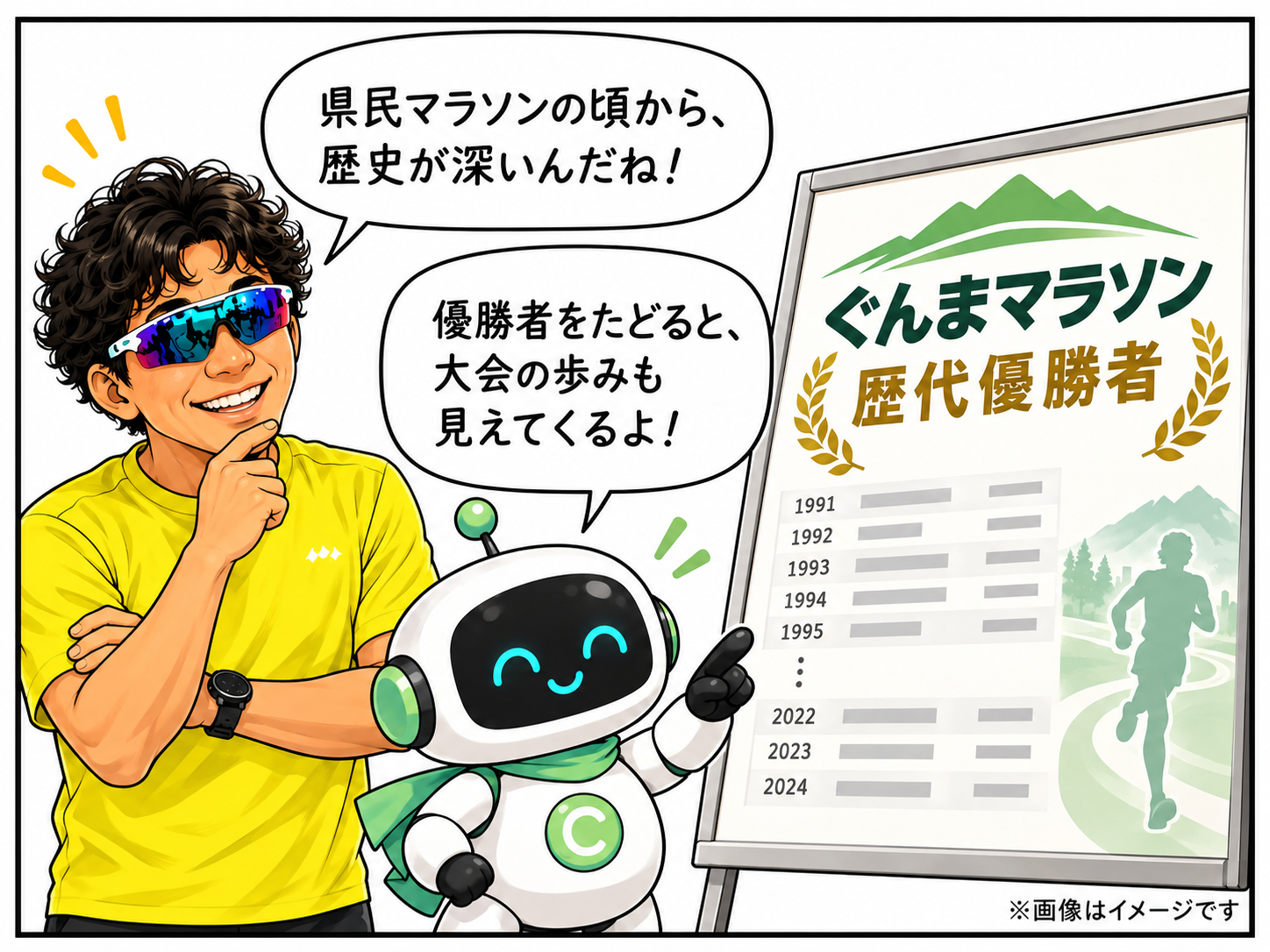
35 Years of Gunma Marathon: The History and Champions of a Japanese Running Tradition
Established in 1991 with approximately 2,500 participants, the Gunma Kenmin Marathon has grown into one of Gunma Prefecture’s established running events. From its original 15K races to the half marathon and today’s full marathon, the event has evolved across 35 years. Drawing on official historical records, we explore the race’s development, its first champions, repeat winners, and athletes who went on to compete internationally.
The birth of the Gunma Kenmin Marathon in 1991
The Gunma Marathon is an established annual road-running event in Gunma Prefecture, Japan.
Its history began on November 4, 1991, under the name Gunma Kenmin Marathon.
The inaugural edition attracted approximately 2,500 runners and featured three events: a 15K race for prefectural residents, a sanctioned 15K road race, and recreational riverside jogging.
The first 15K champions included Makoto Kosuda, Tomie Tamura, Junya Tatsuzawa, and Ryoko Suda across the respective divisions.
Unlike today’s event, the original competition did not include a full marathon.
A new format in 1993
The third edition, held in 1993, introduced half-marathon and 10K races in place of the 15K.
The start and finish also moved to the Gunma Prefectural Athletics Stadium, now known as Shoda Shoyu Stadium Gunma.
Toru Sekiguchi won the 1993 men’s half marathon in 1:06:24, while Takeshi Sakamoto won the men’s 10K in 29:12.
International athletes also appeared among the winners. Italian runners S. Famiro and M. Bagnoli won men’s half-marathon titles during the 1990s.
By 1995, entries had exceeded 10,000 for the first time.
Repeat champions and fast performances
The historical records reveal many repeat winners.
Satoko Kitagawa won the women’s half marathon four consecutive times between 1995 and 1998.
Kaori Shinjo claimed five women’s half-marathon titles between 1999 and 2006.
Kenichi Okada accumulated multiple victories in the men’s 10K.
Takanori Fujii achieved six consecutive men’s half-marathon wins from 2005 through 2010, returning to win again in 2014.
Among the notable individual performances were Kazuyuki Koike’s 28:15 in the 1997 men’s 10K, Kenji Sato’s identical winning time in 2000, and Fujii’s 1:03:42 in the 2005 half marathon.
Times from different years should, however, be interpreted with care because courses and race conditions may have changed.
An Olympic representative among the champions
Miki Igarashi won the women’s 10K three consecutive times from 2004 to 2006, recording 36:56, 34:45, and 34:38.
Igarashi had represented Japan in the women’s 10,000 meters at the 1992 Barcelona Olympics.
Her appearances illustrate how an established regional road race can attract athletes with international competitive experience.
The event continues to grow
In 2009, when the half marathon gained Japan Association of Athletics Federations certification, entries reached approximately 14,000, then the highest total in the event’s history.
The competition had developed into a major gathering of recreational and competitive runners.
The arrival of the full marathon in 2015
The 25th edition in 2015 introduced a full marathon, replacing the half marathon.
A total of 14,742 participants took part across the marathon, 10K, and riverside jogging events.
Sho Matsumoto became the first men’s marathon winner in 2:20:06.
Tomomi Sawahata won the inaugural women’s race in 2:41:15.
The following year, the event was renamed the Gunma Marathon.
According to the organizers, the simplified name was intended to encourage participation from both inside and outside Gunma Prefecture.
Champions of the full-marathon era
Tomomi Sawahata has been a dominant figure in the women’s marathon.
She won four consecutive editions from 2015 through 2018 and another five consecutive editions from 2021 through 2025, totaling nine victories through 2025.
Her 2021 winning time was 2:37:02.
In the men’s marathon, Yuji Shibukawa won in 2018, 2019, 2022, 2023, and 2024.
The 2025 results list a winner with a variant kanji spelling of that name, in 2:17:49. Confirmation is needed before treating the differently written names as the same individual.
Such records demonstrate the importance of repeat champions within the event’s history.
A future World Championships finalist
The 10K has maintained its own competitive history alongside the marathon.
Kana Kobayashi won the women’s 10K in 2022 with 34:06 and again in 2023 with 34:23.
She later ran 2:21:19 at the 2025 Osaka Women’s Marathon and placed seventh in the women’s marathon at the 2025 World Athletics Championships in Tokyo.
Her results provide an example of a regional road-race winner who went on to compete successfully at the international level.
The complete historical list includes many other runners from Japan and abroad, with diverse competitive backgrounds.
Cancellation and recovery
The 30th edition in 2020 was canceled because of the COVID-19 pandemic.
The event resumed in 2021 with infection-prevention measures.
Riverside jogging returned in 2022, and further operational changes followed, including wave starts in 2024.
These developments are also part of the history of the event.
Chappy’s running fact: How should historical winning times be compared?
Historical race results can be fascinating, but comparisons require context.
The event has featured 15K, half-marathon, 10K, and full-marathon competitions across different periods.
Courses and race conditions have also changed.
A winning time is not necessarily a course record, nor does it alone establish the competitive strength of an era.
To understand a race’s history, it is important to consider both results and the circumstances in which those results were achieved.
Toward the 36th edition in 2026
On November 3, 2026, the Gunma Marathon is scheduled to hold its 36th edition.
From an inaugural 15K event with approximately 2,500 participants to a modern full marathon, its history reflects the development of recreational and competitive road running in Gunma.
Its past champions represent only part of that story.
Thousands of other participants, volunteers, organizers, and spectators have also contributed to the event over the decades.
The original Kenmin Marathon and today’s Gunma Marathon are chapters of the same continuing tradition.
The winning records preserve an important part of the region’s sporting history.
Sources
Gunma Marathon official history and winners:
https://www.g-marathon.com/history/
Japan Association of Athletics Federations, Kana Kobayashi:
https://www.jaaf.or.jp/athletes/profile/kana_kobayashi/
World Athletics, Tokyo 2025 championships report:
https://worldathletics.org/jp/competitions/world-athletics-championships/world-athletics-championships-tokyo-2025-7190593/news/report/day-2-report-world-athletics-championships-tokyo-25
Runner’s Rings – Rings Journal
Every road carries the history of those who ran it.