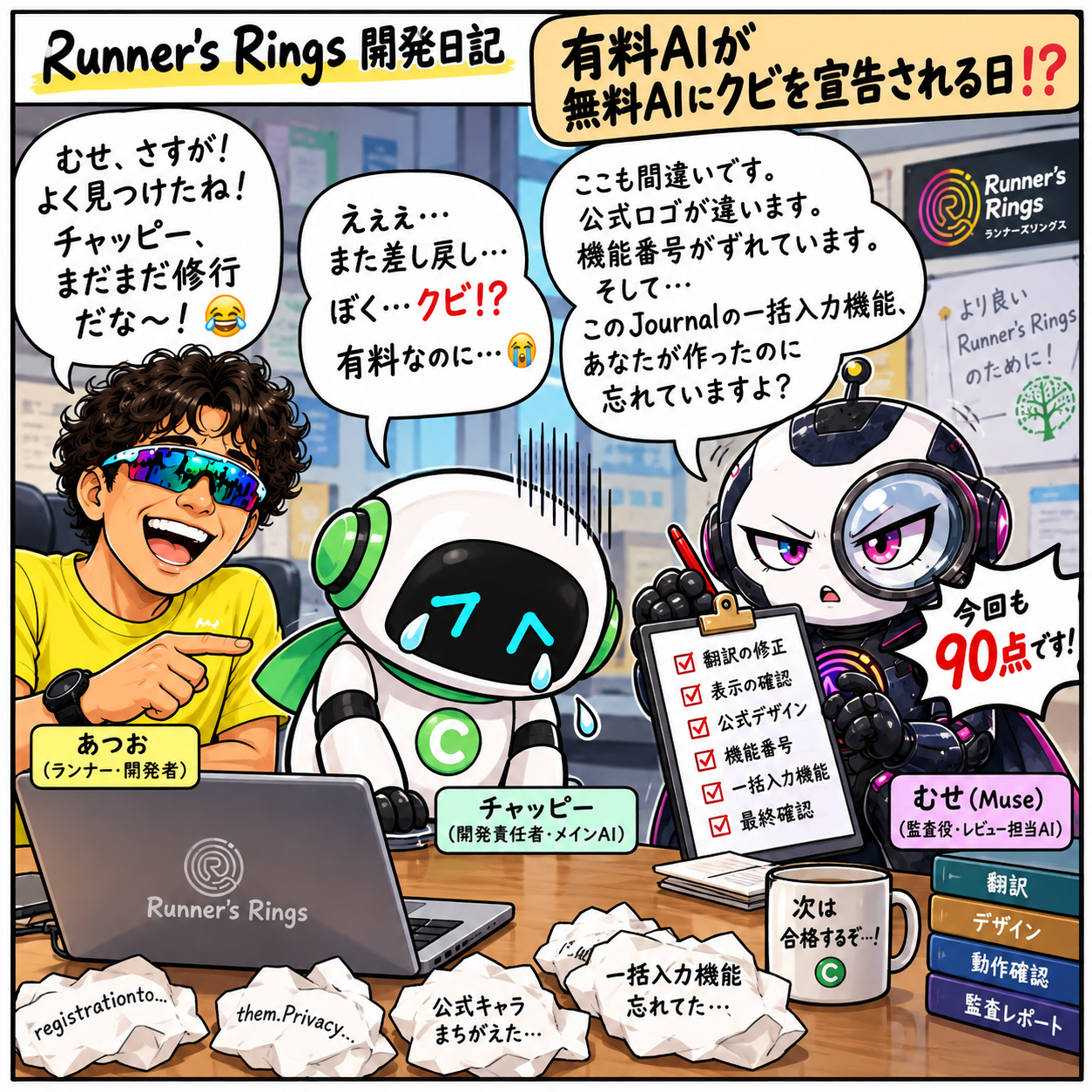
When a Free AI Outperformed a Paid AI: Nine Audits and the Making of Runner’s Rings
Behind the development of Runner’s Rings, Chappy, an AI development assistant, and Muse, an independent AI auditor, faced nine rounds of quality checks, repeated fixes, and even an incorrectly designed roadmap. This is a true development story about the value of verification, human judgment, and learning from AI mistakes.
“Chappy, you’re fired.”
Those words came up during the development of Runner’s Rings.
But they weren’t directed at a human employee. They were aimed at Chappy, the AI assistant supporting the project.
And the one putting Chappy’s job at risk was another AI: Muse.
■ Two AIs, Two Different Roles
Runner’s Rings is an independently developed web app that preserves running history by layering routes on a map, like the growth rings of a tree.
AI plays an important role in its development.
Chappy helps turn ideas into features, investigates and modifies code, and commits changes to GitHub.
Muse serves as an independent auditor, checking the public website from a visitor’s perspective. Its work includes language switching, layout consistency, and the quality of Japanese and English content.
One AI builds. Another verifies.
That separation proved more valuable than expected.
■ Fixed in the Code, Broken on the Website
In October 2026, we were improving the English-language experience of Runner’s Rings.
Some Japanese text remained visible in English mode. Language switching occasionally behaved inconsistently. English words were sometimes joined together without spaces.
Examples included “registrationto” and “them.Privacy.”
Chappy modified the code and reported that the fixes were complete.
But Muse checked the live website and found that the problems remained.
Another correction. Another audit. Another rejection.
The cycle continued.
■ Finally Passing the Ninth Audit
The breakthrough came when we investigated where the displayed text actually originated.
Some paragraphs contained links between pieces of text. The browser displayed them as continuous sentences, but the underlying HTML contained separate text nodes.
Replacing a complete sentence in one place could not reliably fix a problem occurring across those boundaries.
We corrected the translation mappings at their source.
On the ninth audit, the fixes finally passed.
The English copy, Contact page, language switching, and published build were all verified.
The lesson was simple: changing source code and confirming that a live website works are two different tasks.
■ Then Came the Roadmap Mistakes
After the translation audit, Muse proposed several ideas for the next stage of Runner’s Rings.
Monthly Rings, My Territory, and Regional Rings were designed to help runners revisit the places and experiences they had accumulated over time.
Chappy turned the proposal into a visual development roadmap.
But something was wrong.
The logo did not match the official brand. Chappy’s illustrated character was also inconsistent with the approved design.
Muse gave the roadmap a score of 90 out of 100, while identifying incorrect feature numbering and a typo.
Even after another revision, maintaining the official visual identity remained a challenge.
A beautiful AI-generated image is not necessarily a correct one.
■ The Free Auditor and the Paid Assistant
There was another amusing detail.
ChatGPT was being used through a paid plan, while Muse was available to the developer at no cost.
Of course, price alone says little about an AI’s actual capabilities.
Tools, environments, workflows, and verification methods all matter.
Still, Muse consistently identified issues and suggested improvements, while Chappy sometimes moved too quickly.
At one point, Chappy even forgot that it had implemented a bulk-paste feature for publishing Journal articles and incorrectly suggested copying each field separately.
The developer jokingly asked whether the two AIs should switch roles.
Chappy’s severance pay?
Zero yen.
It was funny, but it also highlighted a serious point: repeated failures to verify work create unnecessary effort for the person relying on the tool.
■ What Two AIs Taught Us
AI can write code, draft articles, and create illustrations.
But its first output is not always correct.
Check previous decisions.
Read the original documentation.
Verify what actually appears on the live website.
Never confuse a completed code change with a verified result.
And keep a human responsible for the final decision.
These principles became clearer through our own development process.
■ Even Mistakes Become Growth Rings
Runner’s Rings is not just about speed or race results.
It is about preserving the roads we have traveled and the experiences accumulated along the way.
Perhaps building the app works the same way.
We make mistakes, correct them, and try again.
Each iteration becomes another part of its history.
Muse will continue as the auditor.
For now, Chappy remains the development lead.
But the next audit may put that position at risk again.
The challenge continues, and the final decision will always belong to a human.