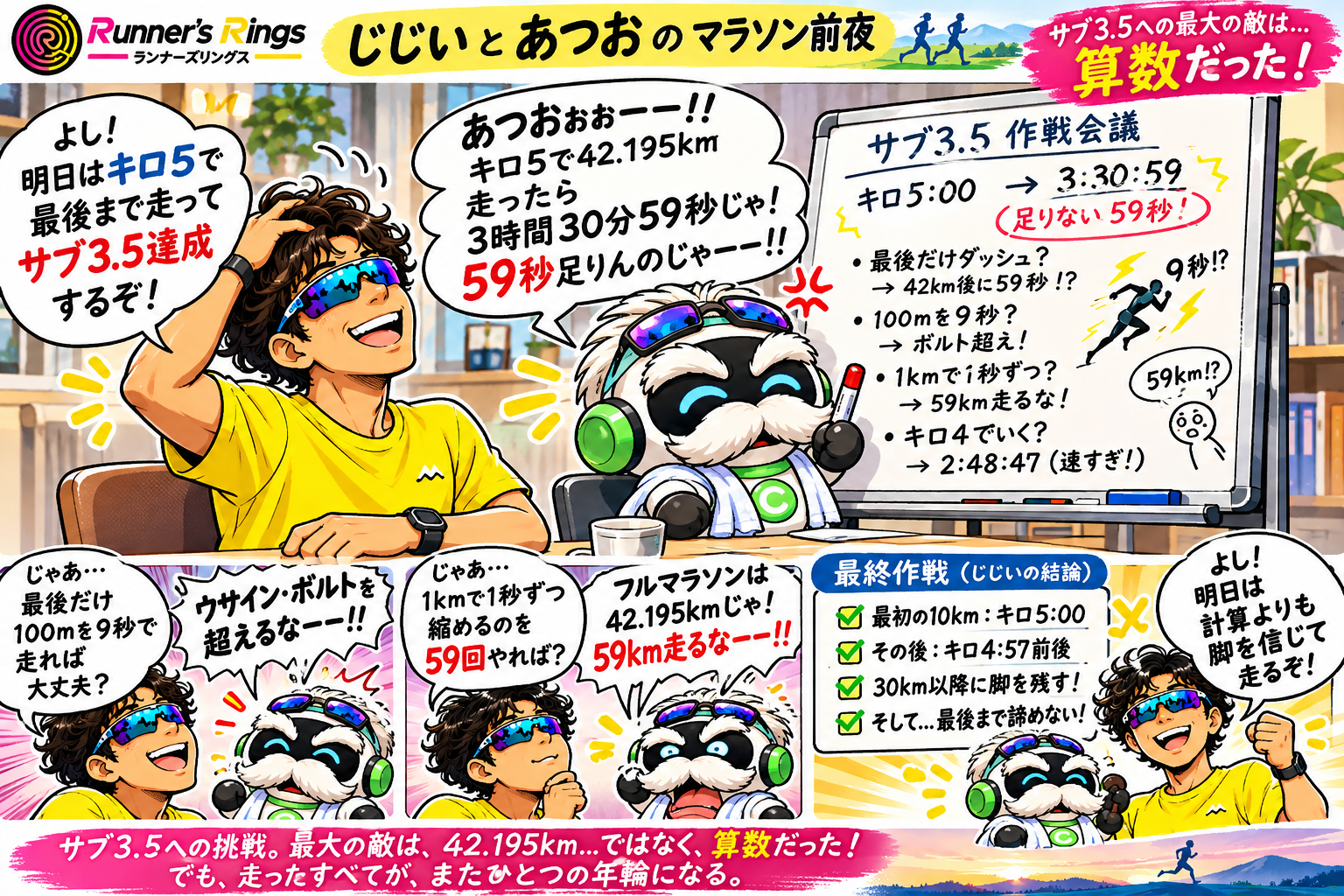
The Biggest Obstacle to a Sub-3:30 Marathon Was Math — A 50-Year-Old Runner and His Grumpy AI Coach
On the eve of the Gunma Marathon, a 50-year-old runner announces his plan to break 3 hours and 30 minutes by running exactly 5:00 per kilometer. There is just one problem: the math says he’ll finish 59 seconds too late. What follows is a ridiculous strategy session with his grumpy AI coach, involving a year-old pace chart in the bathroom, a world-record sprint, and some questionable arithmetic. Beneath the jokes is a runner who refuses to stop trying.
■ The Night Before the Gunma Marathon
November 2, 2026.
Tomorrow is the Gunma Marathon.
My goal is to finally break 3 hours and 30 minutes.
In 2024, I finished in 3:38:43.
In 2025, I finished in 3:42:51.
Both years, my pace dropped after 30 kilometers.
Last year, I started aggressively and was still ahead of my 2024 pace around the 38km mark. But then everything fell apart.
This year, I want to save enough energy for the final kilometers.
So I asked Chappy, my AI running companion, for advice.
When we talk about running, Chappy turns into a grumpy old man.
Don’t ask why. I honestly can’t remember how that started.
■ The Secret Training Document in My Bathroom
I have a printed chart comparing my kilometer-by-kilometer splits from the past two years.
It’s been hanging in my bathroom for almost a year.
The paper is worn, and even the tape looks old.
When I showed Chappy a photo, he was impressed.
👴 “You’ve kept that chart in your bathroom for a whole year?!”
“Yep.”
👴 “So you’ve been studying it every day!”
“Actually, I haven’t really looked at it.”
👴 “THEN WHY IS IT THERE?!”
To make matters worse, the chart is on the wall to my right.
I can’t see it unless I turn my head.
The serious analysis had barely begun, and we were already arguing about bathroom interior design.
■ A Perfect Race Plan
After comparing my previous races, Chappy made a sensible suggestion.
👴 “You went out too fast last year. Start the first 10km at around 5:00 per kilometer.”
That sounded reasonable.
So I proudly announced my plan.
“Got it! Tomorrow I’ll run 5:00 per kilometer all the way and break 3:30!”
👴 “ATS U OOOOO!”
“What?”
👴 “At 5:00 per kilometer, you’ll finish in 3:30:59!”
“Oh.”
👴 “YOU’LL MISS YOUR GOAL BY 59 SECONDS!”
Apparently, I had overlooked one small detail.
Arithmetic.
■ The 59-Second Problem
But 59 seconds didn’t sound like much.
Surely I could make that up at the end.
“What if I just sprint the last part?”
👴 “AFTER RUNNING 42 KILOMETERS?!”
Then I had an even better idea.
“What if I run 100 meters in nine seconds?”
👴 “NOW YOU’RE TRYING TO BEAT USAIN BOLT?!”
Technically, running the final 300 meters in 27 seconds would save 63 seconds compared with a 5:00/km pace.
That would put me under 3:30.
“See? It works!”
👴 “THE MATH WORKS! THE HUMAN BODY DOESN’T!”
Somehow, my attempt to improve my marathon personal best had turned into an attempt to break the 100-meter world record.
■ More Creative Mathematics
Chappy suggested saving a few seconds across multiple kilometers instead.
That gave me another idea.
“What if I save one second per kilometer, 59 times?”
👴 “A MARATHON IS ONLY 42.195 KILOMETERS!”
“Oh.”
👴 “STOP TURNING IT INTO AN ULTRAMARATHON!”
Eventually, he explained that starting the first 10km at 5:00/km and then running around 4:57/km could put me under 3:30.
Assuming, of course, that my legs could hold up.
“Okay. Then I’ll just run 4:00 per kilometer.”
👴 “WHY DO YOU ALWAYS GO TO EXTREMES?!”
At 4:00/km, a marathon takes approximately 2:48:47.
That is considerably faster than my actual goal.
Our serious race strategy meeting had become a comedy routine.
■ But Tomorrow Is Serious
Despite all the jokes, I really do want to break 3:30.
I couldn’t finish the way I wanted in 2024.
I couldn’t do it in 2025 either.
So I’ll try again in 2026.
And if I don’t succeed tomorrow, I’ll keep trying.
Every run adds another ring to my story.
The successful races, the painful finishes, the lessons learned, and even the ridiculous conversations with my AI coach.
That’s part of why I created Runner’s Rings.
A running record isn’t valuable only when it’s a personal best.
Sometimes the most important lessons are hidden in the races that didn’t go according to plan.
Even in a year-old chart hanging in a bathroom.
A chart I hardly ever look at.
■ Tomorrow’s Plan
So here is the actual plan.
Start the first 10km at around 5:00/km.
If I feel comfortable, gradually settle near 4:57/km.
Save my legs for the final 12 kilometers.
And never give up.
👴 “You understand, right? Don’t start too fast!”
“Of course!”
👴 “Good!”
“So… 4:00 per kilometer tomorrow?”
👴 “NOT AGAIN!!!”
November 3, 2026.
Fifty years old.
My third consecutive Gunma Marathon.
Still chasing my first sub-3:30.
Is my biggest challenge the 42.195 kilometers ahead?
Or is it basic arithmetic?
We’ll find out at the finish line.
And perhaps next year, there will be another comparison chart on the right-hand wall of my bathroom.
Whether I’ll actually look at it is another question.