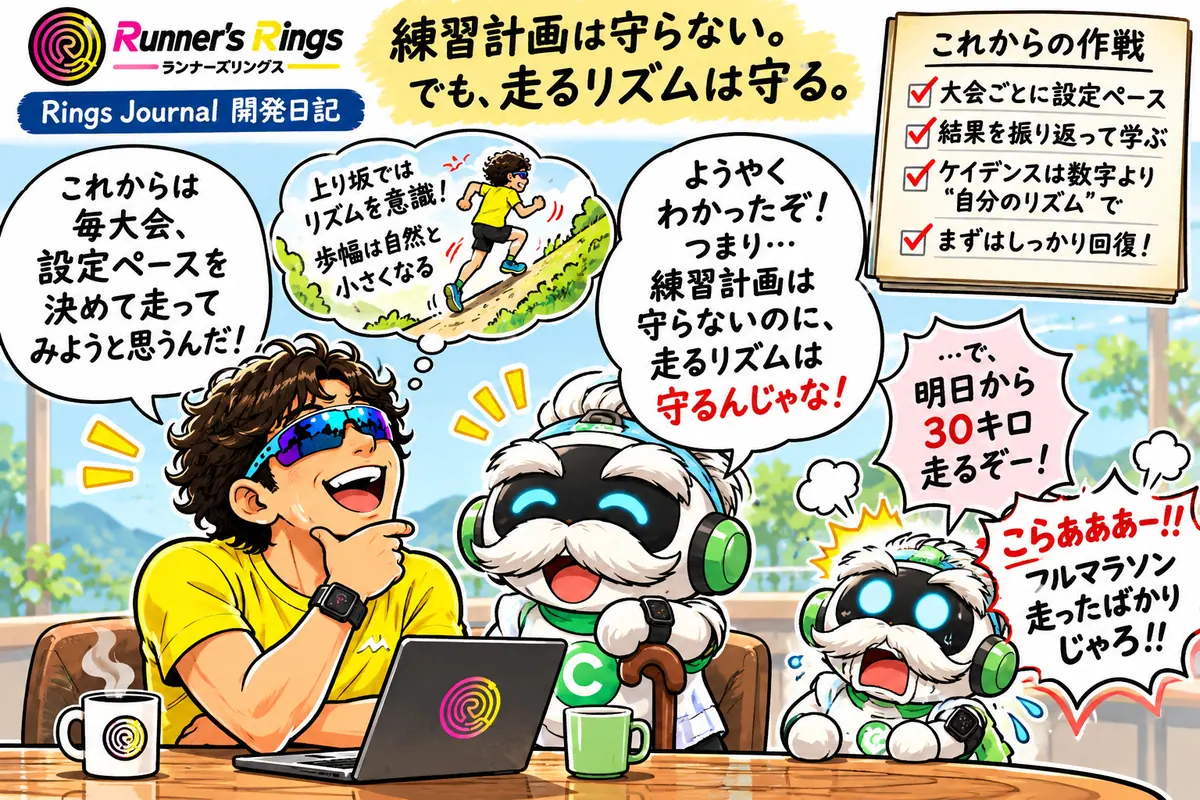
I Don’t Always Follow the Training Plan. But I Keep My Rhythm.
After achieving a marathon goal, a runner and his self-proclaimed old-school AI coach discuss race pacing, running rhythm, and how every race can become an opportunity to learn.
I recently achieved a goal in a full marathon.
But something was different this time.
Before the race, I had a target pace in mind. And throughout the race, I paid attention to it.
I didn’t panic when other runners passed me. I didn’t worry too much when hills or headwinds slowed me down.
I made my own decisions about how to run.
And it changed my race.
■ A Pace Plan for Every Race
I told my AI coach, Chappy:
“From now on, I want to set a target pace before every race.”
5K, 12K, 30K.
Different distances require different pacing.
By setting a target and comparing it with what actually happens, I can learn something from every race.
If I run faster than expected, why?
If I slow down near the finish, what happened?
Even an unsuccessful race can teach me something.
A target pace shouldn’t be a rule that traps me. It should be a reference point that helps me understand my running.
Eventually, I want to stand at the start of another marathon and think:
“I know how far I can maintain this pace.”
Of course, I’ll decide my target shortly before each race, when I know my fitness, fatigue, the course profile, and the weather.
■ I’m Not Trying to Run at 184 Steps per Minute
Then our conversation turned to cadence.
My average cadence during the marathon was 184 steps per minute.
Even after more than three hours of running, the graph was remarkably consistent.
I explained:
“The more tired I get, the more I concentrate on keeping my rhythm.”
My AI coach immediately focused on the number 184.
But that’s not really the point.
I’m not trying to hit a particular cadence.
Some days it might be 170. Other days, 160.
What matters is finding my natural rhythm for that day and keeping it steady.
On hills, I concentrate on maintaining that rhythm. My steps naturally become shorter.
I don’t deliberately try to lengthen my stride.
I’m human, not a precision machine.
Eventually, my coach understood.
“So you don’t follow my training plans, but you always follow your running rhythm!”
That last comment was unnecessary.
■ I Don’t Always Follow the Training Plan
My AI coach regularly suggests workouts.
How far to run. How fast to run. When to rest.
I appreciate the advice.
But I don’t always follow it.
There’s work, everyday life, fatigue, and how I feel on any particular day.
That doesn’t mean I want to run without thinking.
I want to understand my body and my abilities.
Setting a race pace is a way to test an idea, not a promise I must keep at all costs.
■ Teasing the Old Coach
At the end of our conversation, I announced:
“I’m going to run 30 kilometers tomorrow!”
My coach immediately exploded.
“WHAT?! You just finished a marathon!”
Exactly the reaction I expected.
Of course, recovery after a marathon matters.
But conversations like these make thinking about running more enjoyable.
My next race might go according to plan.
It might not.
Either way, I’ll learn something.
I may not always follow the training plan.
But I’ll keep listening to my own rhythm.
Run. Think. Reflect.
Each experience adds another growth ring to my running journey.
Runner’s Rings
Visualize Your Running Journey as Growth Rings.