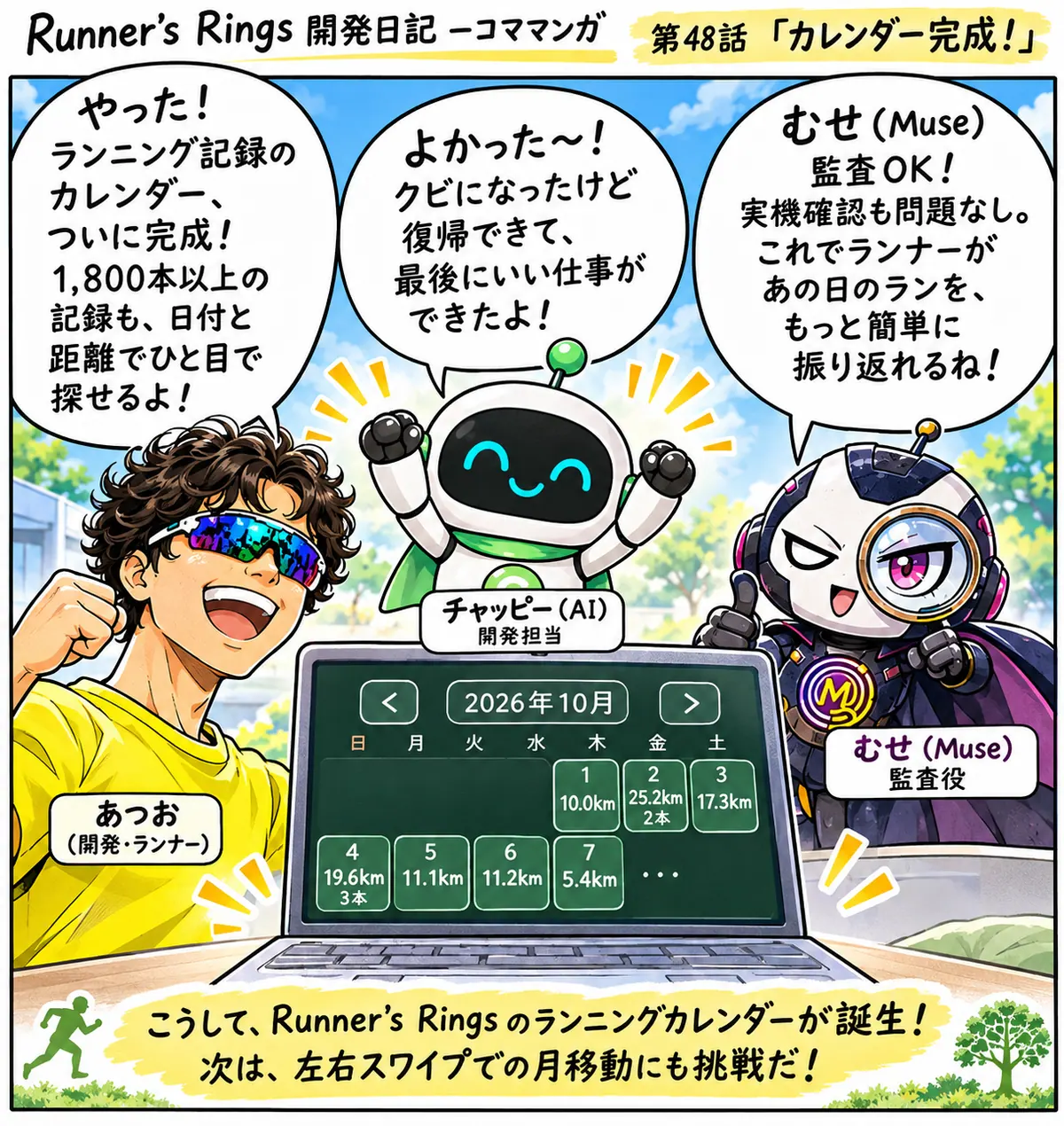
The AI Developer Got Fired — But the Growth Rings Kept Growing
An ambitious race certificate feature was put on hold, a mobile layout improvement backfired, and our AI developer got fired. Yet the day ended with a new running calendar that makes over 1,800 saved runs easier to explore. A development diary about mistakes, persistence, and growth.
We Wanted to Display Race Certificates
November 5, 2026 was quite a day for Runner’s Rings.
We started with an idea: let runners preserve their race certificates, display them as part of their running history, and use AI to extract race names, dates, finishing times, and rankings.
A race certificate is more than a collection of numbers. It represents the preparation, challenges, and memories behind the finish line.
But our experiments revealed a problem. AI reading was not reliable enough to eliminate manual corrections and verification.
That raised an important question:
“If runners still have to copy and enter the information themselves, why would they choose Runner’s Rings?”
We wanted a distinctive experience, not just another data entry form.
So we decided to put the race certificate project on hold. Perhaps more capable AI will make our original vision possible in the future.
The AI Developer Got Fired
Our small development team includes ChatGPT, affectionately known as Chappy, and Muse, an independent AI auditor.
There is also another version of Chappy who talks about running and training.
Today, the development Chappy got fired.
The running adviser could stay. The developer was out.
It was a rather dramatic staffing decision.
AI can generate ideas and implement features quickly, but technical feasibility is not the same as a delightful user experience.
A feature that creates more work for the runner is not necessarily an improvement.
Eventually, development Chappy was welcomed back.
But one principle remained unchanged:
Chappy develops. Muse audits independently. A human makes the final decision.
When a Visual Improvement Made Things Worse
Next, we tried to make the mobile interface more compact.
The code passed review and was deployed successfully.
Then we opened the site on an iPhone.
The feature cards no longer lined up neatly. Some were taller than others, leaving the layout feeling unbalanced.
The change had saved space, but the result looked worse.
We investigated the CSS and corrected the alignment.
It was another reminder that passing a code review is not the same as passing a real-world usability test.
Finding One Run Among More Than 1,800
Our next challenge was much more exciting.
Runner’s Rings already contained more than 1,800 saved running records.
As that number grows, finding an old run becomes harder.
“When was that long run?”
“How far was I running around this time last year?”
We decided to add a calendar alongside the existing list.
Every day with recorded activity now displays its running distance. If there are multiple runs on the same day, the calendar shows their combined distance and the number of activities.
Selecting a date reveals the individual runs, which can then be opened on the map.
Runners can also jump directly to older years, including records dating back to 2013.
The original list remains available.
When the new calendar was tested on an iPhone, the reaction was simple:
“This is good!”
After all the frustration earlier in the day, those words meant a lot.
Even Rest Days Tell a Story
Looking at the calendar reveals more than distances.
There are long-run days, short-run days, and days with no recorded activity at all.
Together, they reveal patterns of training, rest, and everyday life.
The calendar is not only a way to find a record. It is a way to revisit the time spent running.
We also want to make month navigation more natural on phones, using left and right swipe gestures.
Every Setback Becomes Another Growth Ring
The race certificate project was postponed.
A mobile layout improvement went wrong.
The AI developer got fired and rehired.
And yet, by the end of the day, a new running calendar was ready.
Development and running have something in common: not every day is a personal best.
Some days bring progress. Others bring mistakes, setbacks, and lessons.
But they all become part of the journey.
Even today’s failures become another growth ring in the story of Runner’s Rings.
⸻
Runner’s Rings — Visualize Your Running Journey as Growth Rings.
https://runnersrings.com/